


21 April 2026
BSG Reports 47% Increase in Welfare Breaches on Construction Sites

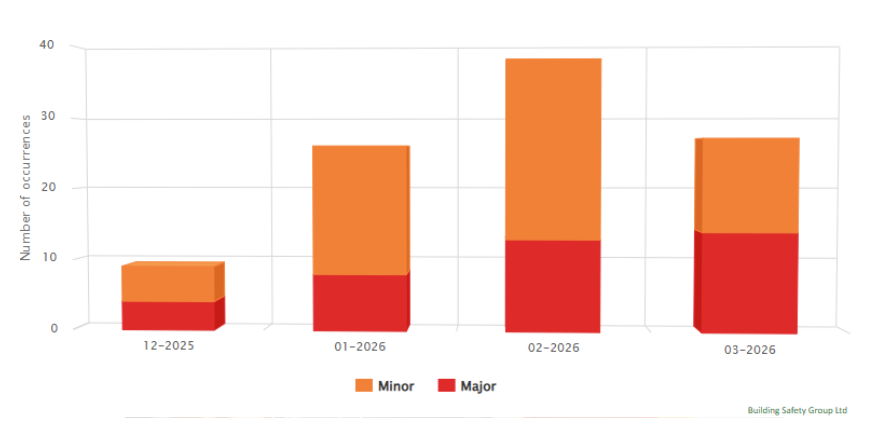
The Building Safety Group (BSG) has reported a concerning 47% increase in welfare breaches across construction sites, based on approximately 10,000 independent inspections conducted over a six-month period comparing Q4 2025 with Q1 2026. This significant rise in non-compliance highlights a troubling trend within the industry and underscores the urgent need for construction firms to prioritise worker welfare as both a legal obligation and a fundamental human right.
Welfare breaches between 1/10/25 – 31.03.2026
Understanding Your Legal Obligations
Under the Construction (Design and Management) Regulations 2015, Principal Contractors and Clients bear explicit legal responsibilities for ensuring adequate welfare provision at all construction workplaces.
These are not discretionary guidelines but mandatory requirements that must be fulfilled before any work commences on site. Schedule 2 of the CDM Regulations 2015 stipulates specific welfare facilities that must be provided, including toilet facilities, an adequate supply of drinking water, both hot and cold washing facilities, secure changing facilities with appropriate gender provisions, and warm, clean areas for rest and eating. Regulation 15(11) makes clear that these facilities must be in place and operational before construction work begins, with maintenance standards upheld throughout the project lifecycle.
The Cost of Non-Compliance
The consequences of failing to meet these requirements extend far beyond regulatory breaches. Toft Construction Limited recently pleaded guilty to breaching Regulation 15(11) of the CDM Regulations 2015, receiving a substantial fine for failing to provide toilet or washing facilities on site. This case serves as a stark reminder that the Health and Safety Executive takes welfare provision seriously, with enforcement action potentially resulting in financial penalties, reputational damage, and even site closures.
Beyond legal ramifications, inadequate welfare provision directly impacts worker morale, retention rates, and industry reputation.
In an increasingly competitive labour market, construction firms that neglect basic welfare standards risk losing skilled workers to employers who demonstrate genuine commitment to workforce well-being.
Expert Perspective on Worker Welfare
Mark Stevens, Regional Manager London, Central and South East at BSG, emphasises the fundamental nature of these requirements: “Having access to a toilet and washing facilities to remove any contamination after carrying out works such as groundworks and bricklaying on site is not a luxury; it is a basic human right. Workers need to feel that they are valued and their health and welfare is taken into consideration by their employer.”
Mark highlights that welfare facilities must be considered during project planning stages and maintained to high standards throughout the entire project lifespan. He notes that contractors working under Principal Contractor arrangements have a duty to verify that provided facilities meet Schedule 2 requirements, rather than assuming compliance.
Common inadequacies identified by BSG include sites providing only cold water taps and no designated eating facilities—provisions that fall significantly short of regulatory requirements.
Proper facilities not only demonstrate legal compliance but actively contribute to preventing occupational health conditions such as dermatitis, which can result from inadequate washing facilities following exposure to construction materials and contaminants.
Implementing Best Practice
Construction firms must integrate welfare planning into the project design phase, ensuring adequate provision relative to site size and workforce numbers. Regular inspection and maintenance schedules should be established, with clear documentation of compliance measures. Principal Contractors must coordinate welfare provision effectively, whilst individual contractors should verify that facilities meet their workforce’s needs and regulatory standards.
Quality welfare provision should be viewed as an investment rather than a cost, with benefits including improved productivity, enhanced worker satisfaction, and reduced health-related absences. Firms are encouraged to exceed minimum standards where feasible, demonstrating commitment to workforce welfare that extends beyond mere compliance.
Taking Action
The 47% increase in welfare breaches represents a critical challenge for the construction industry. Legal and moral obligations demand immediate attention to this issue, with the economic and reputational risks of non-compliance too significant to ignore. Construction firms must review their current site provisions, implement robust welfare planning processes, and foster a proactive compliance culture that prioritises worker well-being.
For further guidance on managing welfare effectively, please take time to read the article on page 15 of our latest newsletter, as well login to the BSG Hub to download our documentation: MS 21 Health, Safety & Welfare Monitoring Report – 2026.docx Source: Mark Johnson | BA (Hons) MA | Communications and External Affairs Manager and Mark Stevens CMIOSH, Regional Manager